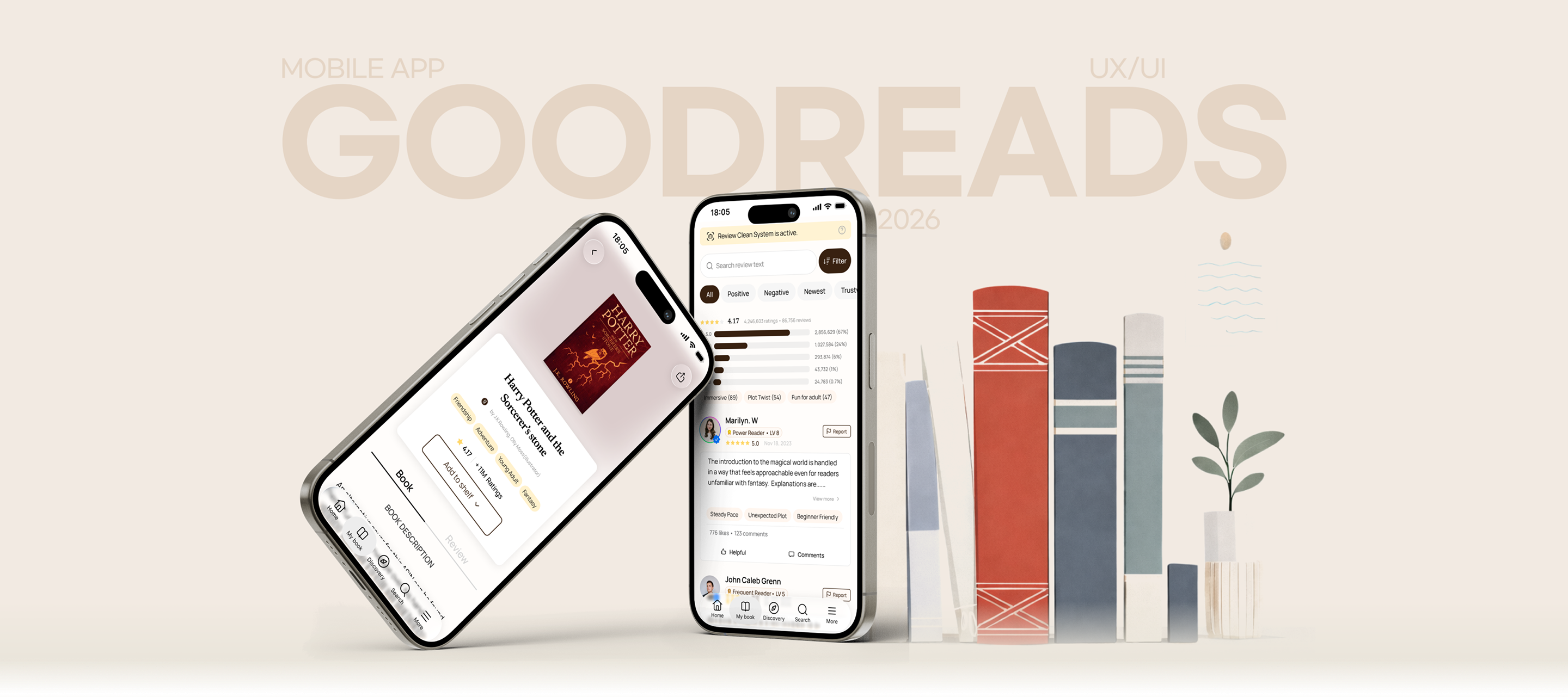
Goodreads
#App revamp
#Trust Recovery
#User Retention
Can you really trust a book’s star rating?
Duration
8 Weeks
Team
Team Project
(2 Designers)
Role
UX/UI Design, User Research, Prototyping, Usability Test
Tools
Figma,
Figjam
Problem
An acquisition meant for growth ended up costing user trust.
Goodreads was built on reader trust. After the Amazon acquisition, promo reviews and fake accounts made reviews harder to trust — pushing users away and weakening trust in both Goodreads and Amazon.
Strategy
Focused Trust Strategy
Reviews are Goodreads’ core trust asset. Instead of redesigning the entire product, I focused on the review experience where users judge whether a book is worth their time.
Impact
Small Fix, Strategic Impact
This small intervention aimed to rebuild core trust and support a direction that could reduce drop-off and strengthen retention.
KEY FEATURE 1/3 ・ BOOK EXPLORE
Explore the book before the score
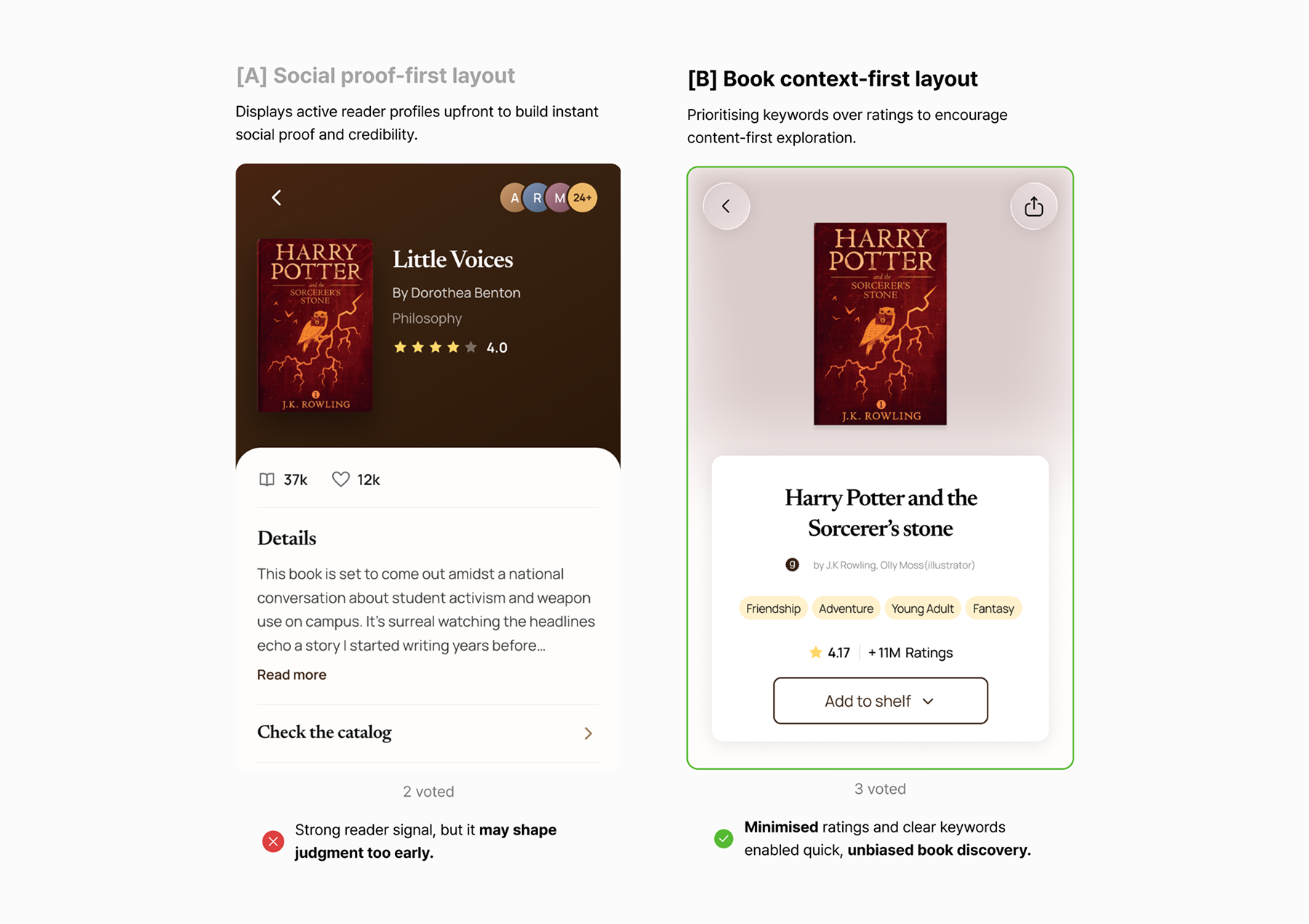
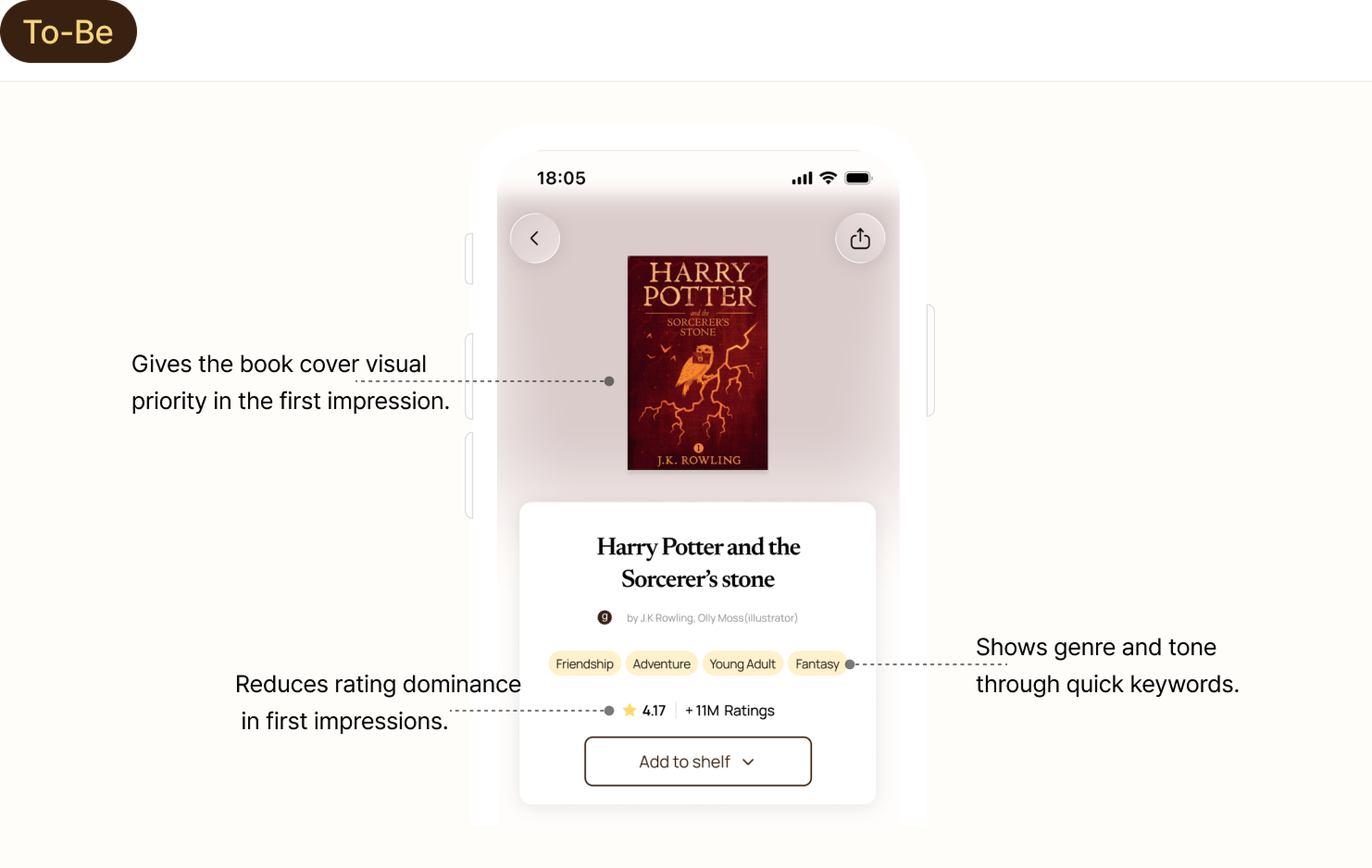
Instead of letting ratings dominate the first impression, Book Explore gives users clearer book context through visual priority, keywords, and a secondary rating placement.
KEY FEATURE 2/3 ・ REVIEW EXPLORE
Filter for relevant perspectives
Guiding users to credible reviews faster through advanced filters, moving past the dominant score to relevant perspectives.
KEY FEATURE 3/3 ・ WRITE A REVIEW
Separate opinion from verified experience
Splitting the review screen into Standard and Verified tabs to verify purchase context, giving users an effortless way to write trusted, badge-backed reviews.
DESIGN THINKING
Why trust matters?
BACKGROUND
Goodreads is built on reader trust.
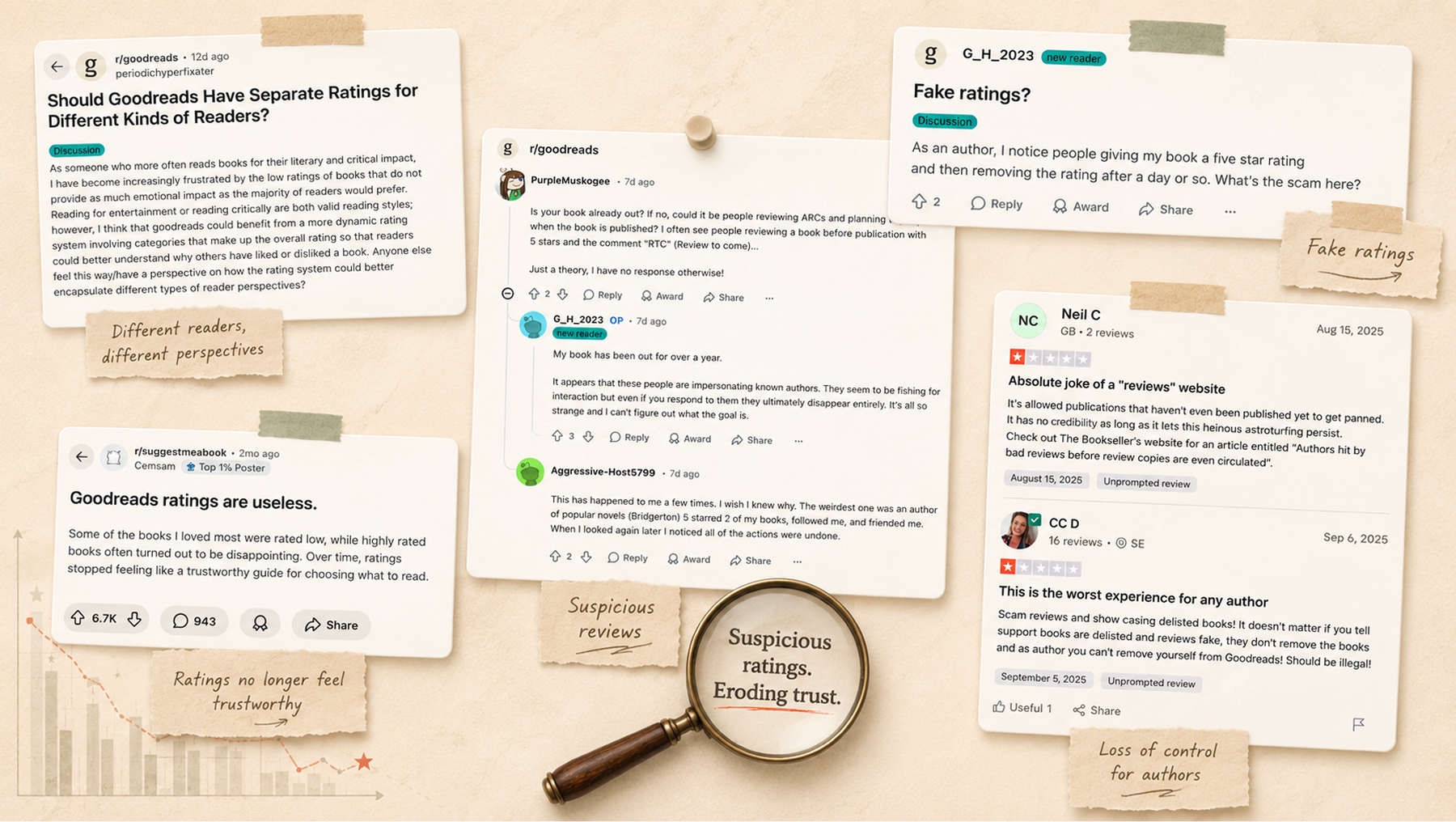
But after Amazon acquired Goodreads, fake accounts, promotional content, and rating attacks made the platform harder to trust.
See research evidence
HOW MIGHT WE
How might we help readers identify trustworthy reviews when deciding what to read?
PROBLEM STATEMENT
Just a review? More than a review issue
On Goodreads, reviews influence what books get noticed, how readers make decisions, and whether users stay or drop off. But users lacked clear cues to judge which reviews were credible, relevant, or based on real experience
See research evidence
DESIGN DIRECTION
How i decided?
DESIGN PRINCIPLE
What if we designed like this?
Rather than redesigning Goodreads from scratch, I used user insights to define three design principles for improving review trust.
See user insights
DESIGN DECISION 01 ・ REVIEW CARD
How can users judge review credibility at a glance?
See user testing evidence  
DESIGN DECISION 02 ・ REVIEW FILTER
How can users find the ratings they need without early bias?
Without clear filters, the dominant score biases users early on. Thus, the goal was to improve information density, empowering seamless review discovery.
See user testing evidence  
DESIGN DECISION 03 ・ BOOK CONTEXT
How can users enable unbiased, content-first exploration?
Ratings appear before book context. The goal was to let users understand the book first, before social proof shaped their judgment.
See user testing evidence  
INSIGHTS BASE 
Evidence & Learning
DESK RESEARCH
Why Goodreads Reviews No Longer Feel Trustworthy
Desk research showed that Goodreads reviews are no longer just reader feedback. They shape industry outcomes, influence reader decisions, and can drive users away when trust breaks down.
The Original Purpose of Goodreads
Goodreads was originally a reader-centred platform where people discover books, track their reading, and use reviews to decide if a book was right for them.
The Impact of Goodreads Reviews
Goodreads reviews and ratings shape how books are discovered, evaluated, and predicted to become popular.
Industry Impact
As Goodreads became connected to book marketing and visibility, reviews started affecting authors, publishers, and market response.
User Drop-off
When negative or unverified reviews dominate the experience, users can lose trust and leave the platform.
1:1 IN-DEPTH INTERVIEW
How do readers decide which book is worth reading?
We conducted 1:1 interviews with readers who use multiple reading apps to understand how they choose books and what they rely on before making a decision.
Moderated remote user interview with Participant 1
Insight 01
Ratings and review volume increased trust.
More ratings and reviews made books feel safer to choose.
Insight 02
Readers rely on social proof to feel confident.
Readers looked to other people’s reactions to feel more confident before choosing a book.
Insight 03
Top ratings and review phrases shaped book perception early.
Readers formed an impression before they explored the book’s details.
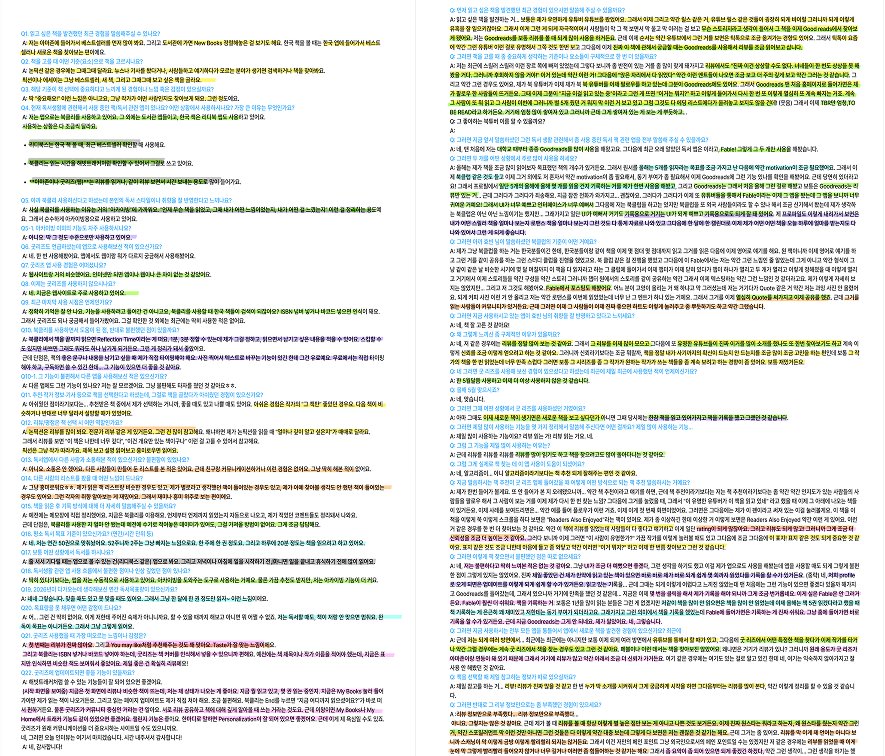
COLOUR CODING & AFFINITY MAPPING
The Review Experience Shapes Trust
I grouped interview notes around review reading, review writing, and Goodreads’ overall review experience, and identified 7 key themes. This helped me see that trust was shaped not only by what reviews said, but also by how they were surfaced, interpreted, and written.
PERSONA
Defining a Persona Around Review Trust
Readers relied on reviews to form early impressions, but struggled to know which ones to trust. So we defined a persona who needs to find credible reviews quickly and choose books with confidence.
STORYBOARD
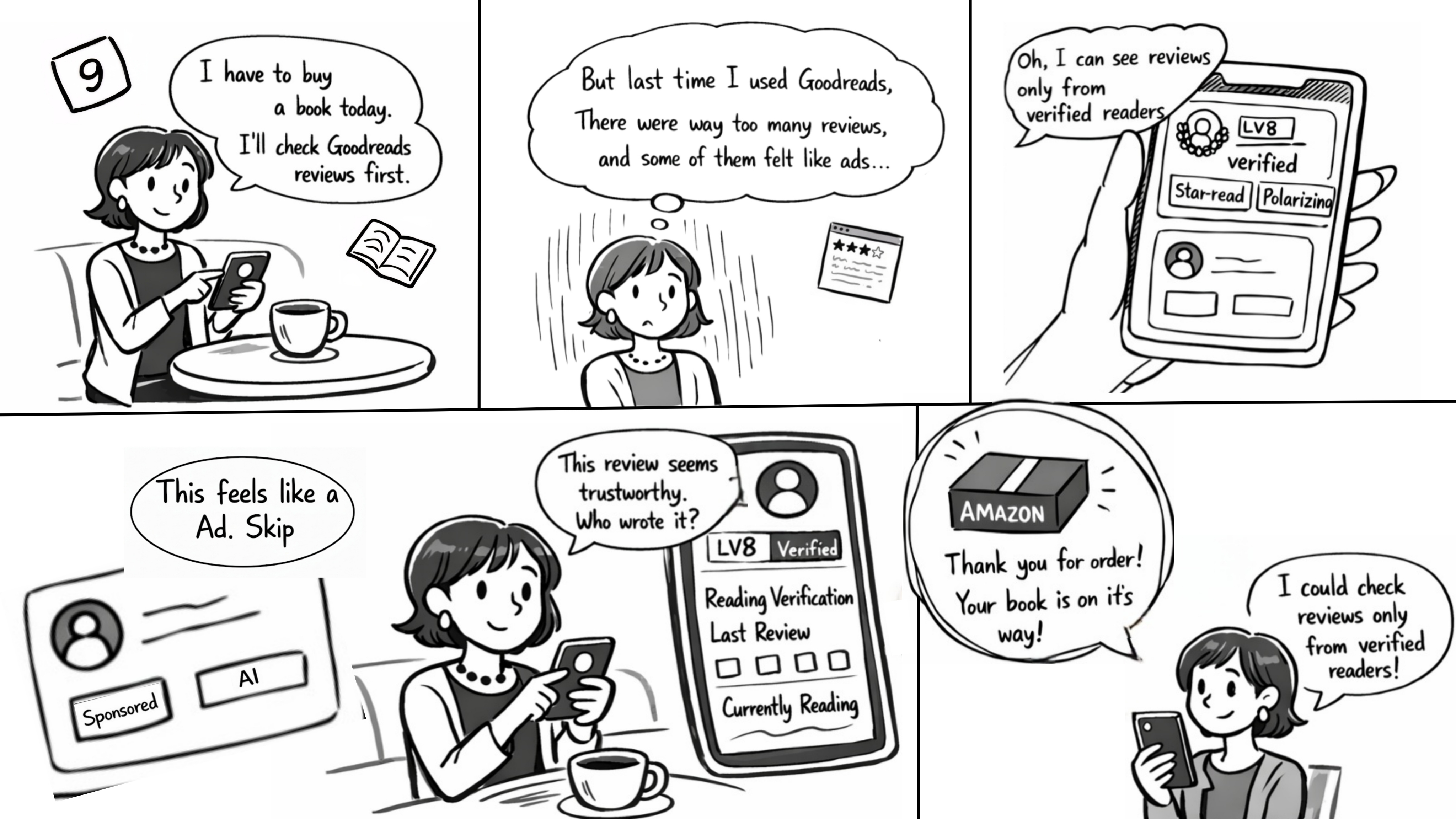
How Review Trust Supports Confident Book Decisions
This storyboard shows how clearer review signals help readers rebuild trust and make confident book decisions. Clearer source, credibility, and relevance cues support both user confidence and business conversion.
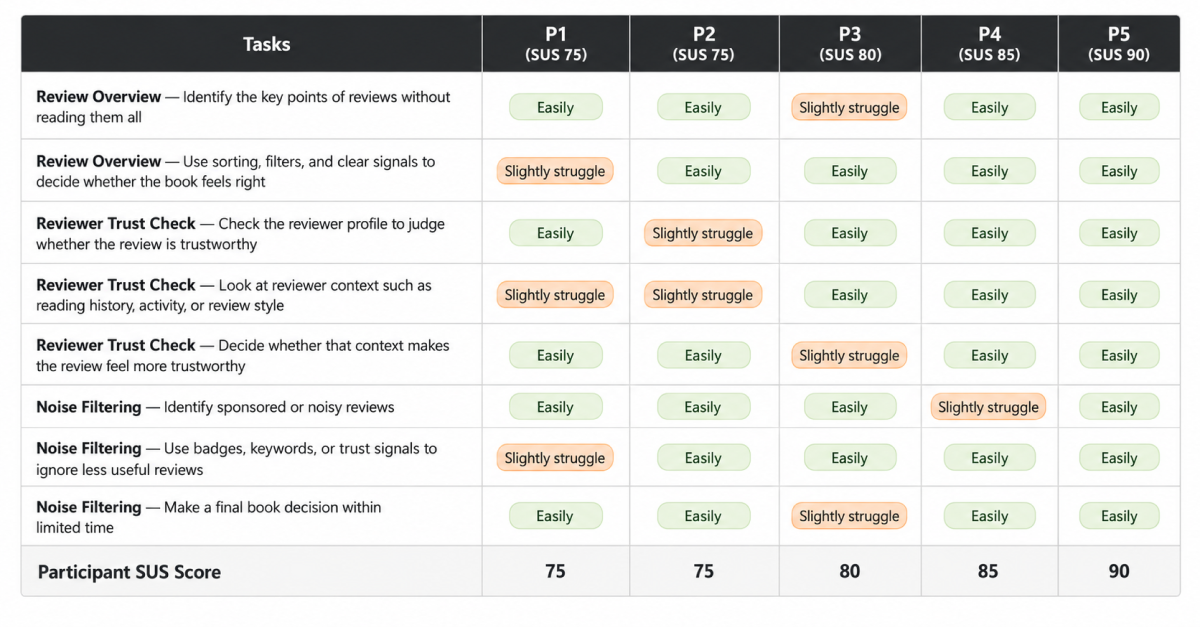
USABILITY TESTING / SUS EVALUATION
Testing Review Trust and Decision Confidence
We conducted a usability test with five participants to evaluate whether users could judge review credibility and make book decisions with more confidence. The redesign scored an average SUS of 81, but some users still needed extra checking to understand which trust signals to rely on.
What I Learned?
Review trust is the core product value
I learned that review trust is not just about improving the interface. It is a core product value that shapes whether users continue relying on Goodreads.
Next Step
Refining the balance between Verified and Standard reviews through data-driven validation
Next, I would test how different balances of Standard and Verified reviews affect book choice, review engagement, and conversion over time.
Why This Design Direction Mattered?
Information hierarchy can shape trust.
This project showed that trust is not created by adding more signals. It comes from placing the right signals in the right order, so users can understand what to rely on without extra effort.
EXPLORE MORE WORK